If you haven’t read the article, Challenging Myself by Drawing Slice of Life Manga!, please check it out first. It includes self-introduction of the writer and how to read 4-koma manga in this blog.

Episode-1 Mishearing
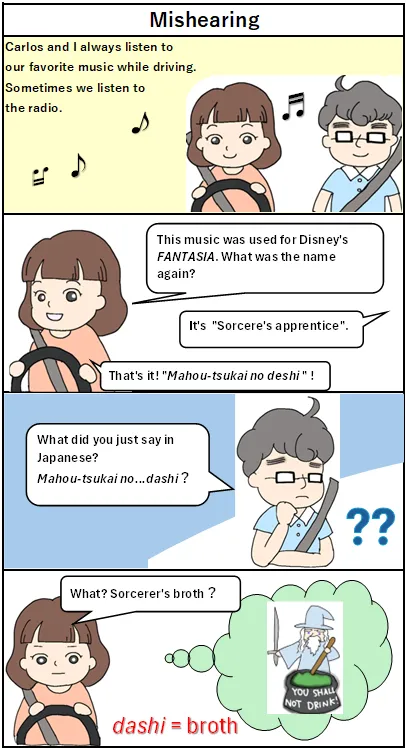
My husband and I often mishear what we say in our conversations.
The number of times that we mishear has been decreasing over the years, but it’s not completely gone. In the manga, Carlos misheard Japanese word deshi as dashi, which is translated as broth in English. It had a strong impression for me since I instantly imagined Gandalf from The Lord of the Rings was making broth with a huge cauldron even though there was no such scene in the movies.
What is Dashi? Is it Different from Broth?
According to Oxford Dictionary,
broth noun [u, c]
thick soup made by boiling meat or fish and vegetables in water.
(Quoted from the Oxford Advanced Learner’s Dictionary 7th edition)
However, I found a different definition of broth online and it said broth is thin and watery.
Dashi is closer to the latter one since it is liquid with umami, and itself has thin flavor. If you are too used to strong flavors in your daily meals, you might feel no flavor in dashi.
What Kind of Dashi is Used for the Japanese Style Dishes?
It is said that there are four basic dashi, konbu(dried seaweed), katsuobushi (bonito flakes), niboashi (dried small fish, it is called iriko in west Japan), and dried shiitake-mushroom. It is common to combine more than two different dashi to make a deeper and balanced taste. Excluding the basics, there are dashi using other ingredients such as clams, dried flying fish or mackerel, vegetables, and etc.
How Do Japanese People Make Dashi?
I remember that packed or canned chicken broth were sold at grocery stores in the U.S. It is convenient and people can use it directly for their cooking. However, this style is not used for dashi. There are three different ways to prepare dashi in Japan.
- (1) Make dashi from the ingredients (dried seaweed, bonito flakes, and etc).
- (2) Use dashi bags that have milled ingredients inside. They are like tea bags.
- (3) Use concentrate dashi powder.
(2) and (3) are easy ways to make dashi since you don’t need to cut ingredients or scale the weight of them. Concentrate dashi powder usually contains seasonings such as sodium and sugar, and also food additives like MSG(monosodium glutamate). If you want to use concentrate dashi powder but want to avoid food additives, you should buy one with the label of 無添加(mu-tenka = no additives).
Episode-2 Differences in the Titles
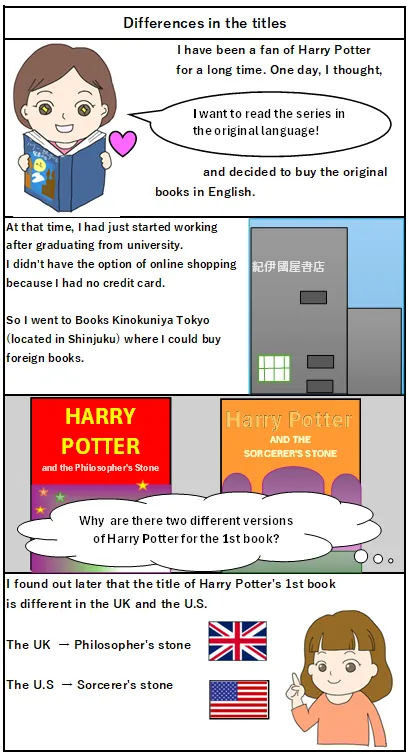
The title of Japanese version of Harry Potter for the 1st book is ハリー・ポッターと賢者の石(harī pottā to kenja no ishi) that is based on the UK version, Harry Potter and the Philosopher’s Stone. There are several different Japanese translations for the word, philosopher, such as 哲学者(tetsugaku-sha), 賢人(kenjin), 思想家(shisou-ka) and etc. Interestingly, there’s only one Japanese translation for the philosopher’s stone, and it is 賢者の石(kenja no ishi). 賢者(kenja) literally means wise-person, but nowadays the word is mainly used for fantasy books, manga, or games.
The Japanese Translations of Wizard and Sorcerer Are the Same.
Both wizard and sorcerer translate to the same word in Japanese, 魔法使い(mahou-tsukai). 魔法(mahou) means magic and 使い(tsukai) means user. Some people translate wizard to 魔法使い(mahou-tsukai) and sorcerer to 魔術師(majutsu-shi). 魔術(majutsu) literally means magic, sorcery or wizardry, and 師(shi) means teacher, mentor, specialist, master, and professional. Some people use different kanji for majutsu-shi like 魔術士(majutsu-shi). Although 士(shi) has the same sound as 師(shi), it means a person with a qualification or skill.
There is no single definition for mahou-tsukai and majutsu-shi, and meanings often change depending on novelists’ or manga-artists’ preferences. There are also 魔導士/魔導師 (both are madou-shi) that are used as the same meaning. I also found some manga artists use カタカナ(katakana) words such as ウィザード(wizādo) for wizard, ソーサラー (sōsarā) for sorcerer, andメイジ(meiji) for mage recently.
The Japanese Word マジック(majikku) Doesn’t Mean Magic.
There are a lot of Japanese words written in katakana that originally came from English. マジック(majikku) is one of them. It sounds like magic, but マジック(majikku) means magic tricks and performance in Japanese. Japanese word マジシャン(majishan)* sounds like magician, but it always means magic trick performers, not magical power users like wizards or sorcerers.
*ブラックマジシャン(burakku magishan = Black Magician) and マジシャンガール(majishan gāru = Magician Girl) from the anime series called Yu-Gi-Oh! are exceptions. They are characters who can use magic (not magic tricks). As far as I know, there are no other famous Japanese anime characters who can use magic and are called マジシャン(majishan).
Episode-3 Philosopher
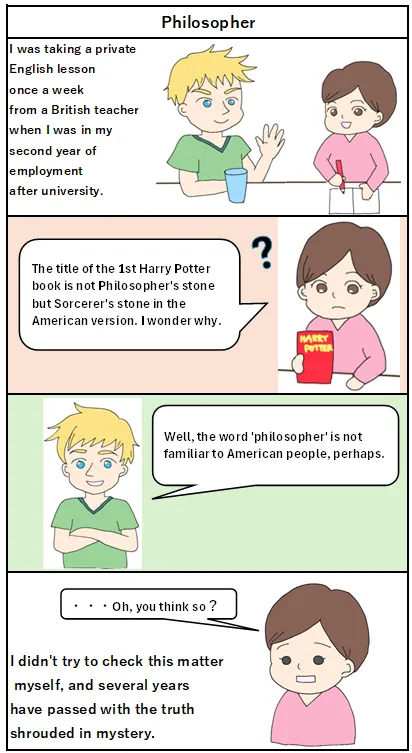
When I first saw these words, realise, learnt, colour, practise, mouldy, and etc. in Harry Potter and the Philosopher’s Stone, I thought they were misspelled. The English we learn at Japanese schools is American English, so I was unfamiliar with British English spellings. If you write the answers using British spellings for an English test, they might be marked as incorrect at schools in Japan (although it depends on the teacher’s knowledge and generosity).
There is Always Demand for British English in Japan.
Even though Japanese students learn American English at schools in Japan, there are always Japanese people who want to study British English, like me. I think the Harry Potter series, including books and movies, has played a huge role in increasing the number of Japanese people who get interested in the UK and British English.
There are English conversation schools that focus on teaching British English, but there are not many. So I searched a British teacher who is living in Japan online and decided to take a private English lesson at a café (since there were no online English lesson services at that time).
Complaining about Teaching English in Japan.
The British teacher I took a private English lesson from was an exchange student who was studying at a college in Japan (if my memories are correct). He was not a professional teacher, but I didn’t mind it because I wanted to have a chance to listen to British English and practice conversation.
One time, I asked him if there was anything he didn’t like when he was doing English teaching to Japanese adults as a part-time job. The answers I still remember are as below.
Complaint (1) : Some Japanese students could speak English only in short sentences, and he had to keep talking one-sided to avoid silence during lessons.
Complaint (2) : Some Japanese students constantly asked him to go out for dinner or a drink after the lesson.
Complaint (3) : One Japanese male student always asked him to go for a drink, and he felt he was being used for picking up women.
I don’t think teachers at English conversation schools have complaints like his. For (1), English conversation schools have curriculums and students have to buy their textbooks. So there is always time for students to read aloud the conversations in the textbooks.
As for (2) or (3), most students try to respect teachers’ private time and also it tends to be late if students wait until all lessons finish to ask teachers to go out for dinner or a drink.
Episode-4 Why Is It the Sorcerer’s Stone?
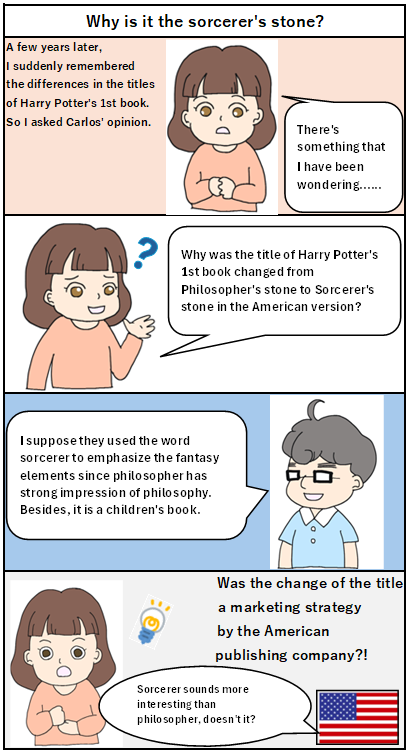
Before finding out the difference of Harry Potter’s 1st book title in the UK and the U.S., I did not know “English” is different depending on the country even if their 1st language is English. I had thought all people in English speaking countries could share the same publications so that translation was not necessary. I was shocked to notice that I had been wrong for a long time, and at the same time I thought it was interesting that there are differences for spellings, words, phrases, dialects, speaking manners and etc. even within the same language.
How about Japanese Titles of Harry Potter Series?
I have mentioned that the title of the Japanese version of Harry Potter for the 1st book is based on the translation of the U.K version. How about Japanese titles of Harry Potter after the 1st book?
In Japanese titles, there is no article before nouns and every noun is regarded as singular.
| Original title | Japanese title | English meaning of Japanese title (direct translation) |
|---|---|---|
| Harry Potter and the Philosopher’s Stone | 『ハリー・ポッターと賢者の石』(harī pottā to kenja no ishi) | Harry Potter and philosopher’s stone |
| Harry Potter and the Chamber of Secrets | 『ハリー・ポッターと秘密の部屋』(harī pottā to himitsu no heya) | Harry Potter and room of secret |
| Harry Potter and the Prisoner of Azkaban | 『ハリー・ポッターとアズカバンの囚人』 (harī pottā to azukaban no shūjin) | Harry Potter and prisoner of azukaban |
| Harry Potter and the Goblet of Fire | 『ハリー・ポッターと炎のゴブレット』 (harī pottā to honoo no goburetto) | Harry Potter and goblet of flame |
| Harry Potter and the Order of the Phoenix | 『ハリー・ポッターと不死鳥の騎士団』 (harī pottā to fushichou no kishidan) | Harry Potter and knight team of phoenix |
| Harry Potter and the Half-Blood Prince | 『ハリー・ポッターと謎のプリンス』(harī pottā to nazo no purinsu) | Harry Potter and mysterious prince |
| Harry Potter and the Deathly Hallows | 『ハリー・ポッターと死の秘宝』(harī pottā to shi no hihou) | Harry Potter and hidden treasure of death |
Some of the Japanese titles are very different from the original English titles. I thought it is interesting that the Japanese translator and publisher chose the word mysterious instead of half-blood for the 6th book. The translation of half-blood is 半純血(han-junketsu) in Japanese. 半(han) literally means half and 純血(junketsu) means pure blood. Although the word 半純血(han-junketsu) is used in the book, it is said that they did not use the word for the Japanese title because Japanese children are not familiar with it, and children can’t understand it means half muggle and half wizard/witch before reading the story.