

Episode ー 5 Wearing Shoes Indoors

When Do Japanese People Take Off Their Shoes? Only at Home?
Japanese people don’t take off their shoes only at home. Many places with tatami flooring also require guests to remove their shoes, including some Japanese-style restaurants, izakaya (casual Japanese taverns), ryokan (traditional Japanese inns), public bathhouses, and tourist sites such as temples and castles. (Tatami is a mat woven from igusa, or soft rush, and is used as flooring in traditional Japanese-style rooms.) Because shoes, and even slippers, can damage the surface of tatami, people walk on it in socks or bare feet.
There Are Places That Require People to Change Their Shoes
In Japan, there are places where you take off your shoes and change into indoor shoes or slippers. Schools, clinics, spas(onsen), and gyms are examples of such places, and the main reason is to keep dirt and dust from being tracked in from outside.
It’s common for schools up through high school to require students to wear indoor shoes called uwabaki inside the building. At both my middle school and high school, I had to have two different pairs of indoor shoes: one for the main school building and another just for PE in the gym. It was a relief when I got to university, since students didn’t have to wear indoor shoes there. I was also happy that, unlike in elementary, middle, and high school, we didn’t have to clean the classrooms ourselves.
The Chance of Your Shoes Being Stolen Is Not Zero, but It’s Close
Public bathhouses and hot springs usually provide shoe lockers, so there’s no need to worry about theft. However, some places, such as ryokan and Japanese-style restaurants with tatami seating, have only an open shoe rack instead of lockers. In that case, someone might accidentally walk off with your shoes, so some places recommend attaching a numbered tag or similar marker to them. Although Japan is considered a safe country, shoe theft and mix-ups do happen. So when you visit a place where you may need to take off your shoes, it’s best not to wear expensive or treasured shoes that you’d hate to lose.
Many Japanese People Don’t Know What a Bed Runner Is
According to one survey, about 60% of Japanese people sleep in beds, while the remaining 40% use futons. Even so, many Japanese people don’t know what a bed runner is. I was one of them. When I stayed at a Western-style hotel in Japan, I wondered, “What is this strip of cloth on my bed for?” Hotels in Japan with many international guests often put bed runners on their beds. A bed runner protects the bedding from dirt when a guest lies down with their shoes still on. Since Japanese people never lie on a bed with their shoes on, some assume a bed runner is part of the comforter or simply a decoration.
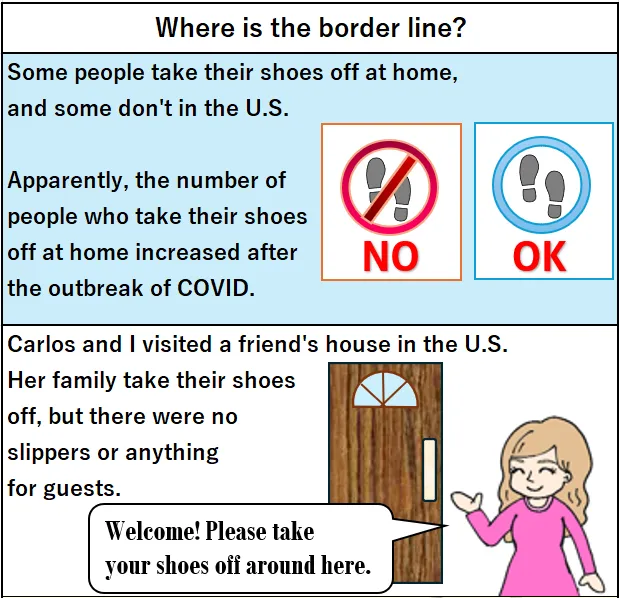
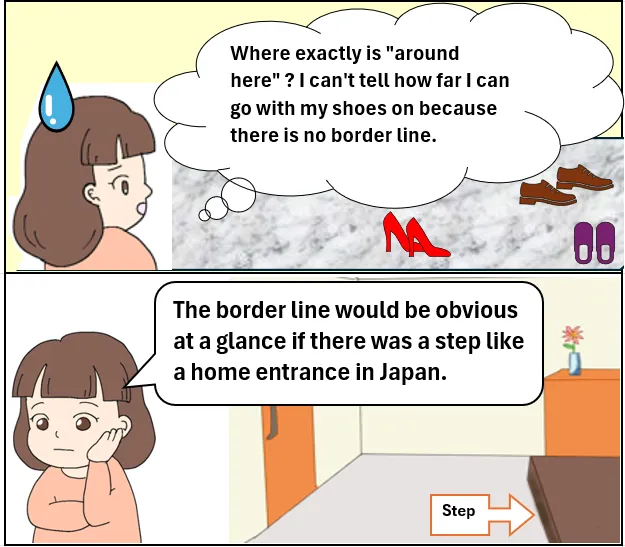
Where is The Border Line?
Why Do I Want to Know Where the Line Is?
No matter how hard you wipe the soles of your shoes on a doormat, you can’t remove all the dirt and dust. If you walk on the floor with your shoes on, the floor gets dirty. I want to know where the line is because I don’t want to get my socks dirty walking on a floor that someone has walked on in their shoes.
Am I too fussy about cleanliness? The answer is no (at least by Japanese standards). I’ve seen many social media posts from Japanese people who dislike airport security checks overseas. At some airports, passengers have to take off their shoes and walk through the security gate in socks or bare feet, on the same floor that airport staff walk on in their shoes. By the way, airports in Japan usually provide slippers, so passengers who remove their shoes for a security check don’t have to walk on the floor in their socks or bare feet.
Even Paramedics Take Their Shoes Off in Japan
You might be surprised, but in Japan, paramedics generally take off their shoes before entering a private home. However, in situations such as disasters, where there may be a risk of injury, they may keep their shoes on or wear protective shoe covers.
Personally, I don’t think paramedics need to take off their shoes in an emergency where every second counts, and I’m sure most people would agree. If you don’t live in Japan, you may wonder, “Who calls an ambulance when it isn’t an emergency?” Unfortunately, some people call an ambulance for minor injuries because ambulance transport is free in Japan (although some areas now charge a fee afterward if the call is judged to have been non-urgent). Since many calls aren’t true emergencies, paramedics often have time to take off their shoes before going inside.
Are There Any Downsides to Taking Off Shoes at Home?
If one advantage of taking off your shoes at home is that it makes cleaning easier, what are the disadvantages? One is that your shoes aren’t within easy reach when you need to evacuate, such as in a disaster. In an earthquake, for example, furniture may topple over and scatter things across the floor, or window glass may shatter and leave shards on the floor. Walking from your room to the entrance barefoot or in socks could easily injure your feet before you even make it outside.