

(目次= Table of contents)
Episode-7 Step Inside a Home’s Entrance
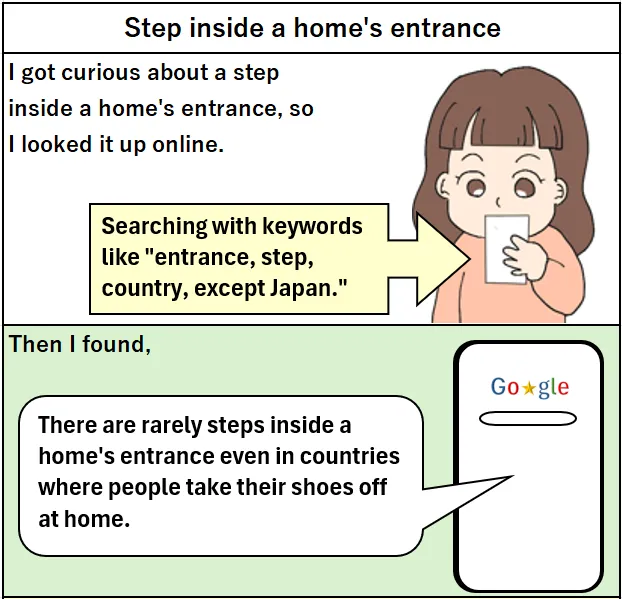
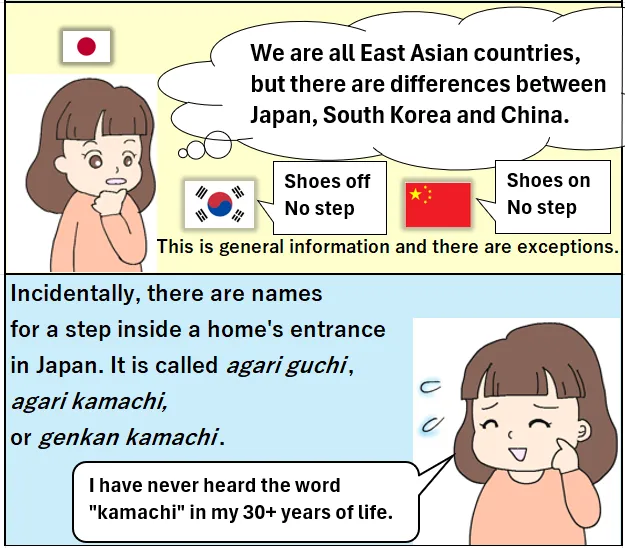
Why Is There a Step Inside a Home’s Entrance in Japan?
The agari-kamachi, the raised step inside the entrance of a Japanese home, does more than clearly mark the boundary between inside and outside. It also helps keep dust and sand from getting into the house, and it gives small children and older people a place to sit while putting on or taking off their shoes. In other words, it’s both functional and convenient!
The Step Is Lower Than It Used to Be
In traditional Japanese houses, the agari-kamachi was typically about 30 cm (12 in) high, because it also helped protect the house from moisture —a factor that can lead to the growth of mold and dust mites. Today, the average height of agari-kamachi is 18 cm (about 7 in) or less in detached houses and 11 cm (about 4 in) or less in apartments (around 5 cm, or 2 in, in condominiums), which is much lower than in the past. Why did it become lower as time passed? The reason is that Japan is super-aged society and the Ministry of Land, Infrastructure, Transport and Tourism’s “Basic Policy on Ensuring Stable Supply of Elderly Person’s Housing” says a height of 18 cm or less is desirable.
By the way, I live in a two-story apartment in Tokyo. It was exactly 11 cm (about 4 in) when I measured the step inside my home. I feel even 11 cm is very low. It’s not high enough to sit on comfortably while putting on or taking off shoes (especially boots). I have my doubts about how functional or convenient a 5 cm (2 in) step really is, but at least it still does its job as a boundary!
Tips for Japanese Leaners : The Kanji 框 (kamachi) Isn’t a Jōyō Kanji
Jōyō kanji (常用漢字) are the 2,136 “regular-use” kanji that students learn during compulsory education (elementary and junior high school) in Japan. The list was revised in 2010, and they increased the number of kanji from 1,945 to 2,136 characters. Since 框(kamachi) is not on the list, Japanese students do not learn the kanji at schools.
框(kamachi) Is a Grade 1 Kanji Kentei Character
The kanji 框 is written with the “tree” radical (木) on the left and 匡 on the right. At first glance, it looks a lot like 国 (country), but it’s slightly different. This character is at the level of Grade 1, the highest and most difficult level of the Kanji Kentei (The Japan Kanji Aptitude Test). Apart from people who work for home builders or in real estate, and kanji masters, most Japanese people aren’t very familiar with the word kamachi. So if you’re studying Japanese and planning to take the JLPT N1 in the future, please don’t worry! You’re very unlikely to see this kanji on the test.
Episode-8 After Taking Off Shoes
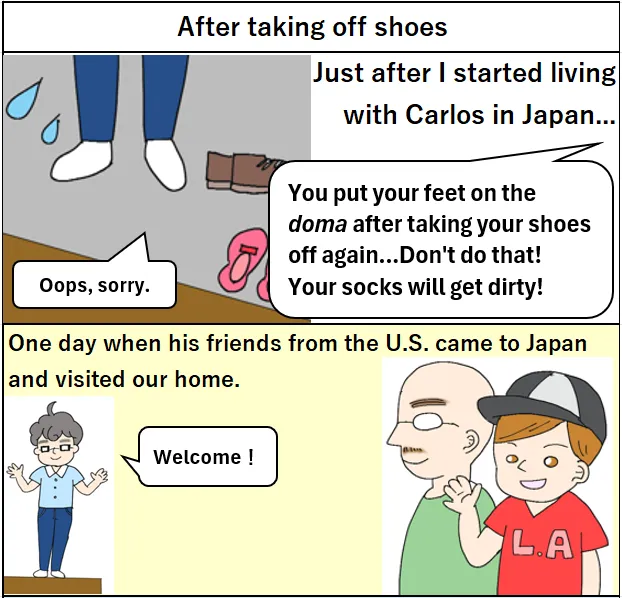
Coincidence, or Common Among People from Overseas to Japan?
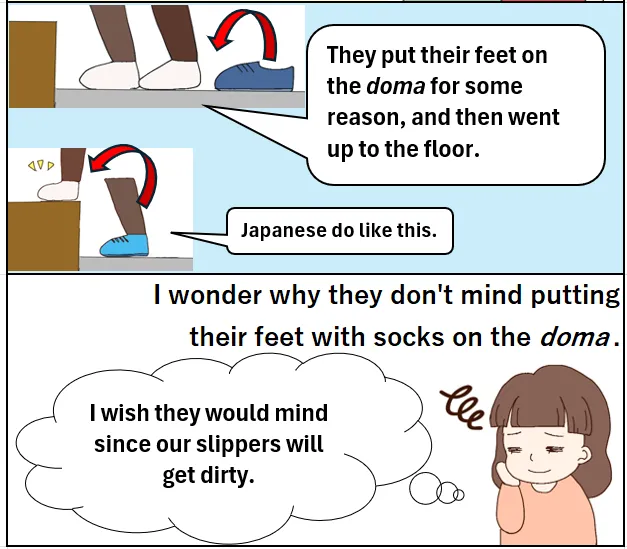
Two of Carlos’s friends appear in this four-panel manga. Both are American, and one of them lives in Japan. Since that friend lives here, I assumed he’d be used to the Japanese way of doing things: stepping out of your shoes directly onto the raised floor of the entryway without putting your feet down on the doma, the lower area where shoes are taken off. But to my surprise, just like Carlos, they stood on the doma in their socks to line up their shoes!
I appreciate it when guests line up their shoes after taking them off, but I would honestly prefer it if they were more careful to avoid standing on the doma in their socks. Socks that touch the doma get dirty, so if you then put on slippers, the slippers get dirty too. If you walk into a room without wearing slippers, the dirty socks will end up making the floor dirty as well. I think some Japanese people might say, “So what if floors get a little dirty? Just clean them! I don’t worry about little things like that!” Please don’t assume that all Japanese people are too strict about cleanliness. In my case, I just want to save myself from the trouble of cleaning by preventing things from getting dirty in the first place. Yes, I’m just a lazy person and not a neat freak!
Do You Want to Wear Shoes in a Japanese Home?
If you’re planning to move to Japan and thinking, “Taking off my shoes is too much effort. It’s my own home, so wearing shoes inside should be fine!” Please be careful because taking off your shoes is the norm in Japanese homes, and rental agreements often don’t bother to say, “No shoes indoors.” (Airbnb listings may include it in their house rules for foreign guests.) Japanese homes aren’t built for wearing shoes indoors. If you wear shoes inside for years, the floors can get badly scratched, which could lead to disputes over restoration costs when you move out of a rental.